
To reconnect with your spouse emotionally, start by naming the distance, making room for an honest conversation, and following through on changes you both agree to make. Closeness grows when each partner feels heard and sees the other making an effort.
You can run a household and still feel painfully alone. The bills get paid. Someone remembers the school forms. But conversations become updates, affection feels awkward, and another suggestion to “plan a date night” misses what’s actually happening. In couples therapy, I help you look at what’s been pulling you apart.
Before you start, understand what is keeping you apart

Emotional distance can grow from exhaustion, unresolved hurt, unequal responsibilities, or repeated defensiveness and withdrawal. What looks like a lack of interest can reflect resentment, disappointment, or feeling too depleted to reach for each other.
Outside pressures count, too. Work hours, health problems, a new baby, and financial strain can leave little attention for the relationship.
Look at what happens between you when connection feels difficult. Does one person push for a conversation while the other shuts down? Has affection faded alongside an uneven workload? Is an old hurt sitting underneath each new disagreement?
If speaking honestly could lead to threats, intimidation, or retaliation, prioritize safety. The National Domestic Violence Hotline explains the risks of joint counseling when abuse is present and can connect you with confidential support.
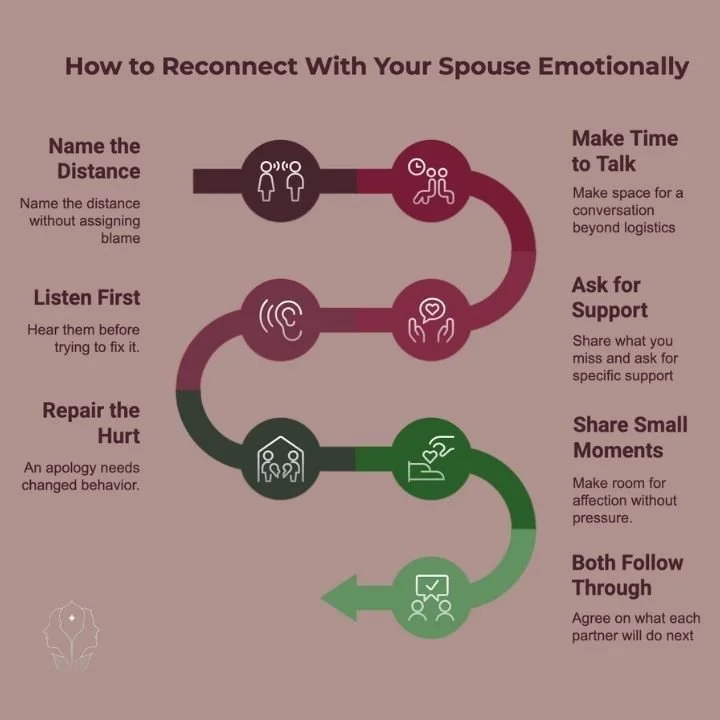
1. Name the distance without assigning blame
Describe what you’ve noticed, how it affects you, and what you miss. A specific observation gives your spouse something to respond to without turning your opening sentence into a verdict on their character.
“We’ve barely talked about anything except the kids this week. I miss feeling close to you.” Opening with “You never care about us anymore” asks your spouse to defend who they are before the conversation has started.
Being clear also means naming unequal effort. “I’ve started our last few conversations about this, and I need you to bring it up next time.”
2. Make space for a conversation beyond logistics

Choose a time when neither of you is rushing, handling another task, or already overwhelmed. Set aside a few minutes to talk about how you’ve each been feeling.
Ask for a specific window, such as fifteen minutes after dinner. A concrete time makes the conversation easier to plan and gives your spouse room to suggest another time.
Put the phones aside and let one topic have space. Asking about something your spouse mentioned earlier shows that their experience stayed with you.
If either of you gets too overwhelmed to keep talking, take a break and agree on when you’ll come back. An open-ended exit can leave the other person wondering if the conversation is over.
3. Share what you miss and ask for specific support

A broad wish for closeness is hard to act on. Explain what you miss, then make a clear request that fits the concern.
“I want more effort” leaves plenty of room for interpretation. “Could you plan some time for us this week and arrange childcare?” makes the responsibility clear.
For an exhausted partner, support could mean someone else taking full ownership of dinner, school communication, or weekend planning. Emotional availability becomes harder when one person is constantly managing the next task.
4. Listen to understand before offering solutions

Repeat what you heard in your own words, then ask if you got it right. Your spouse can confirm what you heard or explain what you missed.
Let them answer before adding your perspective. You can acknowledge the impact of your behavior while still holding a different view of what happened.
Before suggesting a solution, try asking, “Would you like me to listen, or would it help to think through what we can change?”
5. Repair unresolved hurt with concrete changes

Repair means acknowledging what happened, taking responsibility for your part, and changing the behavior that caused harm. An apology loses its value when the same injury keeps happening without meaningful change.
“I’m sorry you felt ignored” leaves the action untouched. Try naming what you did. “I kept checking my phone while you were talking. I dismissed you, and I’m sorry.”
Follow through with a change your spouse can see. If your phone pulled your attention away, put it out of reach before you sit down to talk.
Give your spouse time to see that the change lasts, especially after betrayal or repeated broken promises. Let them decide when they’re ready to forgive.
6. Restore small, mutual moments of connection

Choose everyday interactions that you both welcome, then respond when your spouse reaches toward you. A shared joke, an interested question, or a few uninterrupted minutes can make connection part of an ordinary day.
The Gottman Institute describes responding to small bids for connection as turning toward your partner. In practice, that can be as simple as looking up when they tell you about a rough day and asking what happened.
Let affection happen at a pace that feels comfortable for both of you. A hug can be its own moment of closeness.
Try a small ritual you can both keep up, like coffee before work, a walk after dinner, or a check-in before bed.
7. Agree on what each partner will do next

End the conversation with a small commitment from each person and a time to revisit it.
For example, one of you agrees to handle bedtime twice this week. The other agrees to start a check-in on Sunday. Use that time to talk about what helped and what still felt hard.
Notice who remembers, initiates, and follows through. If you’re still reminding your spouse to do their part, bring that up when you check in.
Questions to ask when reconnecting with your spouse

If you’re unsure how to reconnect with your partner when you feel disconnected, start with one or two of these questions and give each other time to answer.
When have you felt closest to me recently?
What has been taking more out of you than I realize?
Is there something between us that still feels unresolved?
What do you miss about how we used to spend time with each other?
What helps you feel supported by me?
Which responsibility could I take over completely?
What makes it hard to tell me what you need?
What’s one change we could each make this week?
Take a turn answering, too. You may each remember a different moment when you felt close.
Rebuild emotional connection with couples therapy
When every attempt to talk ends in the same argument or silence, I help you slow the exchange down. We look at what triggers the pattern, what each of you experiences, and how to respond differently in the moment.
My work draws on the Gottman Method, Emotionally Focused Therapy, and nervous system awareness. I offer online couples therapy in Florida and South Carolina, along with in-person couples intensives in Central Florida.
We can talk through what’s been happening and which starting point fits your relationship. Book a free consultation or call (321) 413-3482.
Frequently asked questions about reconnecting with your spouse
Can a marriage recover after years of emotional distance?
Yes. Some couples rebuild closeness after years of emotional distance. Both partners need to be willing to address old hurt, change familiar habits, and follow through. Think about what would help you feel close in the life you share now.
How long does it take to reconnect emotionally with your spouse?
There’s no fixed timeline. A good conversation can bring some relief, while rebuilding trust takes repeated experiences of reliability. Look for changes in how you handle ordinary stress, respond to concerns, and repair mistakes.
What if my spouse doesn’t want to reconnect?
You can express what you need and invite your spouse to participate. Reconnecting takes effort from both of you. Individual therapy can help you work through how the distance affects you, clarify your limits, and decide what you want to do next.
Can we reconnect emotionally without having sex?
Yes. Emotional closeness can grow through attentive conversation, shared experiences, practical support, and affection you both welcome. If you want different things sexually, talk about what kinds of affection feel comfortable for each of you.
What if trying to reconnect leads to more arguments?
Slow down and talk about one concern at a time. Previously avoided issues can surface when you begin talking honestly. If conversations keep escalating even after you take breaks, a therapist can help you assess what kind of support fits.